HAVEN at SEST 2026: what hybridisation does to gas turbines in isolated grids
Ciudad Real, Spain, 2 to 4 September 2026
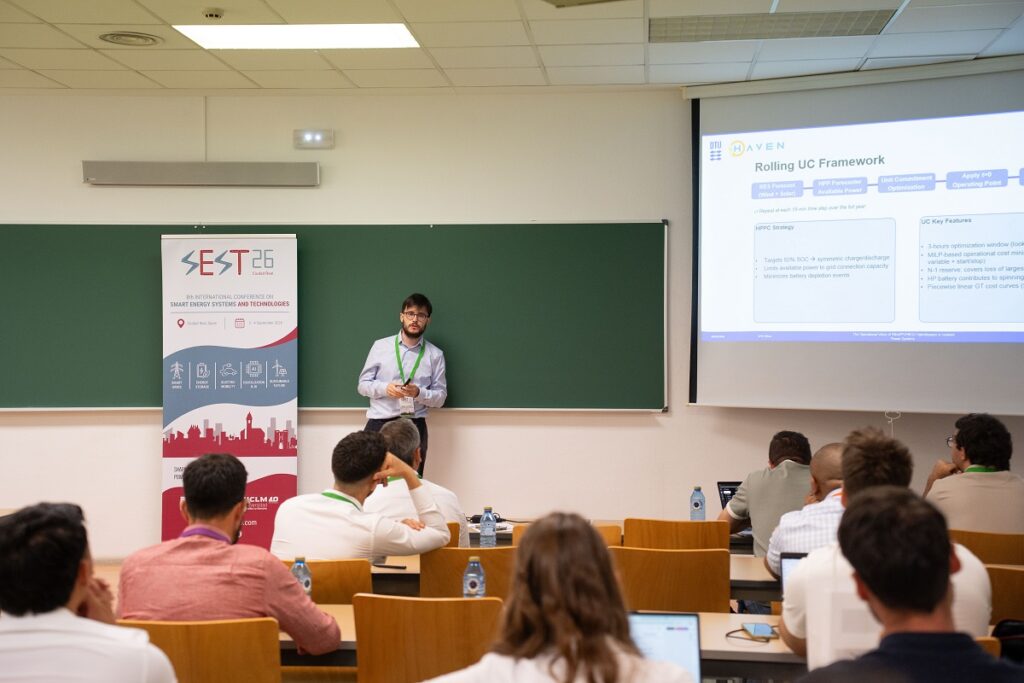
Put wind, solar and two types of battery behind a single grid connection, and the gas turbines on an isolated network start behaving differently. That result was presented on Wednesday 2 September at SEST 2026 in Ciudad Real by Maël Grandin of the Technical University of Denmark (DTU), a HAVEN partner.
The 8th International Conference on Smart Energy Systems and Technologies ran from 2 to 4 September at the Universidad de Castilla-La Mancha, bringing together researchers, grid operators and industry across renewables, storage, power electronics and energy markets. The HAVEN paper, “The Operational Value of the Hybridization of Wind, PV and HESS in Isolated Power Systems”, was presented in session WB1 on renewable generation modelling, assessment and optimisation, and was co-authored with Rujie Zhu, Soheil Pouraltafi-Kheljan, Kaushik Das and Poul Ejnar Sommer Sørensen.
The study builds a rolling unit commitment framework and compares hybrid power plants against standalone wind and PV assets in gas-dominated island systems, where limited grid capacity and variable renewable output push thermal units hard. Coordinating high-energy and high-power batteries with the renewable forecast cuts residual load, moves gas turbines away from inefficient mid-load operation, and removes much of the need to keep them online purely to hold reserve.
That is the architecture HAVEN is building in hardware. Pairing high-energy and high-power battery packs behind a single connection point sits at the centre of the project, and the DTU work puts a system-level operating case behind it, with sizing sensitivities on renewable and storage capacity still to come.
The full paper goes to IEEE Xplore with the rest of the SEST 2026 proceedings, and is available on the HAVEN channels.